Hello!
If you’ve been following my last couple of blog posts, you know I’ve been talking about finishing projects and deciding when they’re ready to launch.
Well, now you know why.
On October 12, I officially launched my newest program, Plus 1 Ads!
I’ve been working on this one for quite a while, and I’m excited to finally share it with you.
Plus 1 Ads is a little different from the safelists, traffic exchanges, and other advertising programs you’re probably familiar with.
And that’s exactly what I had in mind.
Why I Built Plus 1 Ads
I’ve been involved in online marketing for a long time, and I’ve seen an incredible number of programs come and go.
Some were great. Some weren’t. And plenty of good programs probably never received the attention they deserved.
One thing I’ve noticed is that we’re all pretty good at promoting programs, but we’re not always very good at discovering them.
Think about your daily advertising routine.
You visit safelists, surf traffic exchanges, read emails, and see dozens (sometimes hundreds) of advertisements.
How many of those programs do you actually stop to investigate?
If you’re like me, probably not very many.
We recognize the same names, see the same advertisements, and move on.
Meanwhile, there are probably interesting programs out there we’ve never even heard of. And there are marketers trying to get those programs noticed.
What if discovering new programs could become a regular part of our marketing routine, while giving participating marketers a fair opportunity to be discovered themselves?
That’s the idea behind Plus 1 Ads.
So What Exactly Is Plus 1 Ads?
At its core, Plus 1 Ads is a program discovery and referral network for internet marketers.
It’s a place to find programs, keep track of the ones that interest you, and connect with the people promoting them.
Instead of simply showing you an advertisement and hoping you click, Plus 1 Ads encourages you to explore.
You might discover a safelist you’ve never tried, an interesting traffic exchange, a marketing tool, or another program that catches your attention.
Find something interesting? Save it to your personal Portfolio and come back to it later.
But there’s another side to it.
If you’re already promoting a program, Plus 1 Ads gives you an opportunity to introduce it to people who are actively exploring.
You can discover programs worth joining while helping other people discover yours.
How Does It Work?
I wanted the daily routine to be simple.
When you join Plus 1 Ads, you can participate in Today’s Discovery.
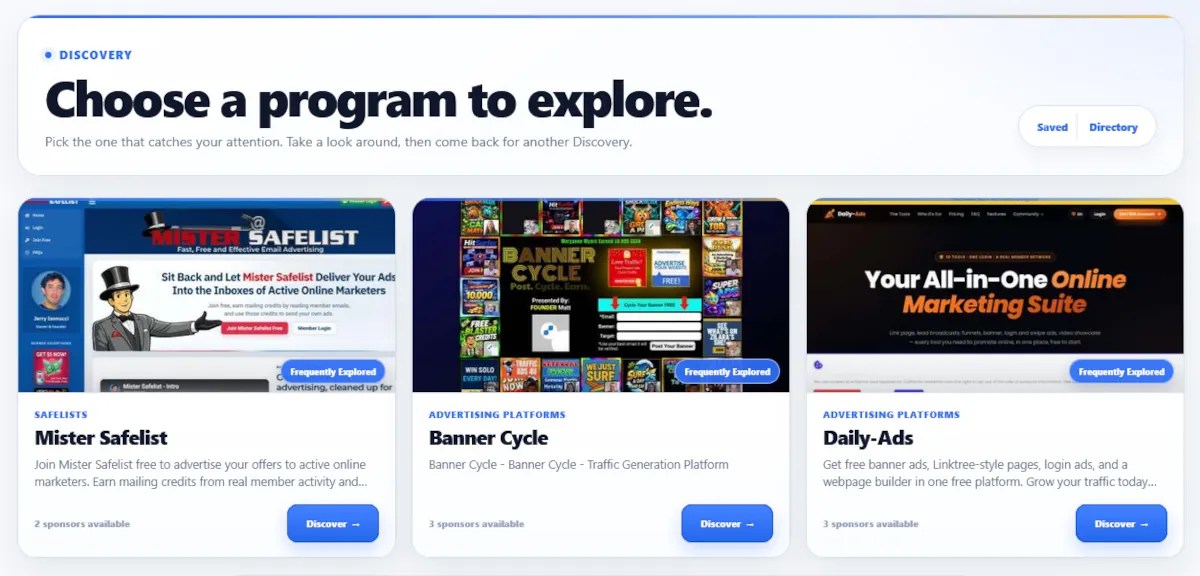
Each day, you’re presented with programs to explore. You can take a closer look, save anything that interests you, or move on to the next one.
Complete seven discoveries and you’ve finished your daily participation.
That’s it.
No spending hours clicking advertisements or collecting credits.
If you’re already a member of a program you’d like to promote, you can add your referral information and choose it as your Active Program.
By continuing to participate in Discovery, you create opportunities for other members to discover the program you’re promoting.
And you can follow your results to see how that exposure turns into interest, sponsor choices, and referral visits.
You Can Choose Who You Join Under
Here’s something else I wanted to do differently.
Normally, when you click an advertisement for an affiliate program, you’re taken straight to someone’s referral link.
You might not know anything about that person.
With Plus 1 Ads, discovering a program and choosing a sponsor are two separate things.
When you find a program that interests you, you can learn more about it and, when sponsor choices are available, see some of the marketers promoting it.
You can visit their profiles and decide who you’d like to join under.
I like that idea because the people behind these programs matter, too.
Maybe you recognize someone. Maybe you like the programs they promote. Or maybe their profile gives you a reason to connect with them.
Instead of automatically sending you through whoever happened to place the advertisement, Plus 1 Ads gives you a choice.
Participation Matters More Than Spending Money
One of my goals was to give everyone a fair opportunity to participate.
I didn’t want Plus 1 Ads to become another advertising system where the people spending the most money automatically receive the best exposure.
There is a Pro membership with additional tools and features, but paying doesn’t buy better sponsor priority.
Free members can participate in Discovery, promote a program, and have opportunities to be discovered just like Pro members.
I wanted participation to matter more than the size of someone’s advertising budget.
It’s Live. Come Take a Look!
Plus 1 Ads officially opened on October 12, and it’s been exciting to finally see people using something I’ve spent so much time building.
Members are exploring programs, building their Portfolios, and participating in Discovery.
Of course, it’s still early. I’m sure there will be plenty to learn as more people join.
For now, I’m just happy to finally share it with you.
And you don’t even need to create an account to take a look.
You can browse the public Directory, explore the available programs, and even give Discovery a try.
If you like what you see, membership is free.
And if you do give it a try, I’d genuinely love to hear what you think.
Until next time,
Jerry